
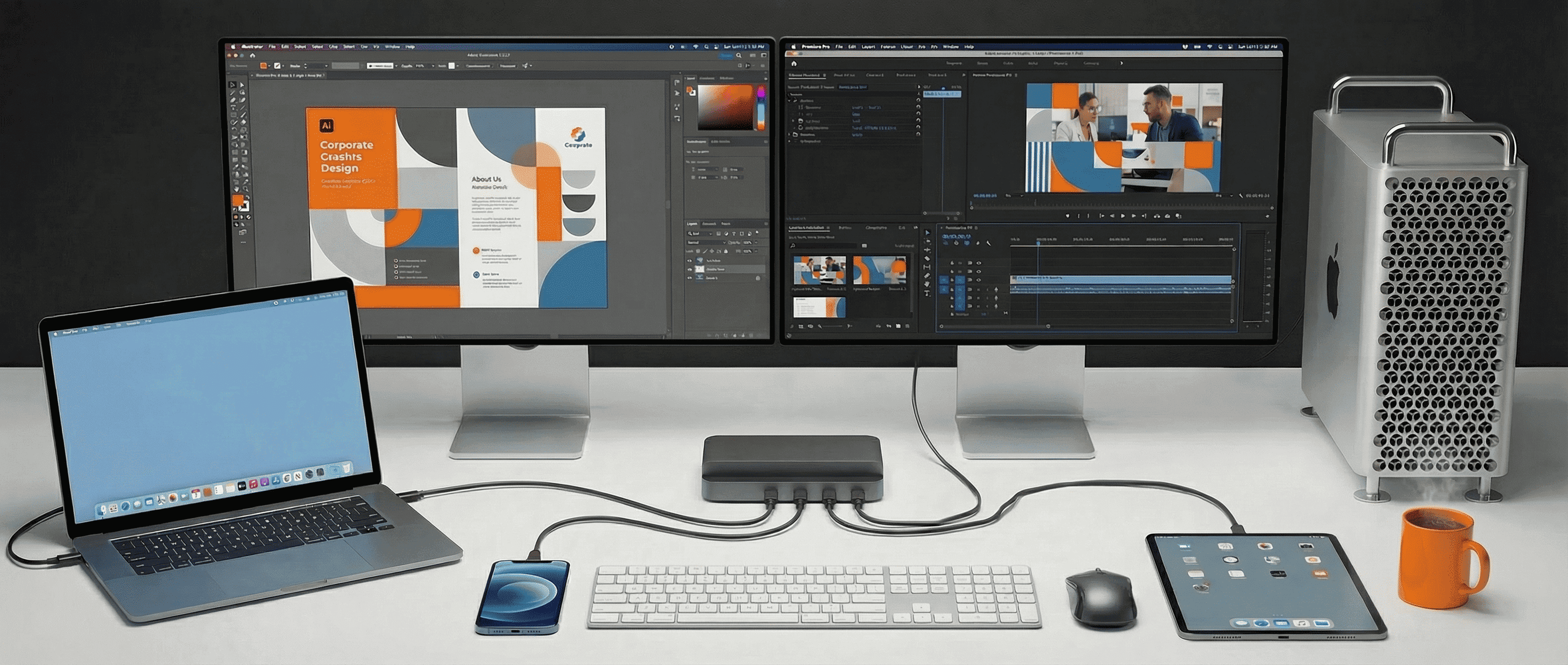
Every Device on Your Desk Deserves a Dedicated Lane.
Before AI. Before storage. Before compliance. There is the fabric — the physical layer that determines what everything else is allowed to become.
Infrastructure is invisible until it isn't. The Wi-Fi router in the corner of the office is invisible until a video call drops. The shared switch is invisible until four people try to move large files at the same time. The single Ethernet cable running to the NAS is invisible until someone realises it's become the bottleneck for everything the team does. Good infrastructure earns its invisibility. The kind that doesn't — the kind that was designed for a simpler setup than the one you're actually running — makes itself known constantly, in small ways that accumulate into a persistent drag on the working day.
Most professional desks today are running infrastructure designed for a simpler era. The dock was built when one laptop was the norm. The home router was built when one or two devices shared the connection. The NAS was built for a time when getting files from one machine to another was an occasional need rather than a constant one. The physical layer underneath the modern professional's work life has not kept pace with how that work life actually looks.
What a Fabric Is, and Why It Matters
A fabric, in networking terms, is an interconnect — the physical infrastructure that lets multiple devices communicate with each other at speed. The internet is a fabric. A corporate LAN is a fabric. What has been missing, until now, is a fabric designed specifically for the desk: a small, personal network that gives every device in a professional's immediate environment a dedicated, high-speed connection to shared resources, without the switches, the configuration, and the IT overhead that enterprise fabric requires.
The distinction between shared bandwidth and dedicated bandwidth is the one that matters most here. When four devices share a connection — as they do on Wi-Fi, and as they often do on a managed switch with insufficient throughput — they are competing for the same resource. One device transferring a large file slows down what every other device can do simultaneously. The experience degrades in proportion to usage, which means it degrades most at exactly the moments when the team is most active.
This is not a marginal improvement. It is a qualitative change in how the infrastructure behaves. A fabric that provides dedicated bandwidth to each connected device does not degrade under load. It does not produce the unpredictable performance that makes shared infrastructure frustrating to depend on. It behaves the same way at peak usage as it does at quiet moments — which means the people using it can stop thinking about it and focus on the work.
USB as the Universal Language
The insight behind RocketBox's physical fabric is that USB-C is already everywhere. Every modern laptop has it. Every professional carries cables for it. It requires no driver installation, no network configuration, no IT ticket. It is the most universally understood physical connector in professional computing — and at current USB generations, it is capable of delivering the kind of dedicated, high-speed bandwidth that previously required enterprise networking equipment to achieve.
Building the fabric on USB means that the infrastructure a team needs to share storage, share network access, and — eventually — share AI compute, arrives through the same cable that was already going to be on the desk. There is no new category of hardware to learn. There is no specialist to call. The fabric is the cable. The cable is already there.
Why the Physical Layer Is the Foundation
Software can do remarkable things, but it cannot exceed what the physical layer permits. A team's ability to share files is bounded by the speed of the connection between machines. An AI model's ability to serve multiple users simultaneously is bounded by how much bandwidth each user's session can draw on. A compliance system's ability to enforce data boundaries is bounded by whether those boundaries exist at the hardware level or only in application software above it.
Every capability that RocketBox delivers — shared storage, multi-user AI, hardware-enforced compliance, institutional context management — sits on top of the fabric. The fabric is what makes those capabilities reliable rather than intermittent, fast rather than adequate, available to every connected device rather than only to the one that happened to get the wired connection. It is not the most visible part of what the platform does. It is the part that makes everything else possible.
Infrastructure That Gets Out of the Way
The goal of good infrastructure has always been the same: to be so reliable, so fast, and so consistent that it stops being a variable in how work gets done. The best office networks are the ones nobody thinks about. The best connectivity is the kind that removes the question of connectivity from the equation entirely, so that the only thing left to think about is the task itself.
That is what the context fabric is designed to be — not a product feature, not a specification to compare, but a layer of infrastructure that earns its invisibility by working exactly as expected, every time, for every device, without asking anything of the people who depend on it.
More Articles
Why We Built RocketBox
RocketBox started with a simple frustration: modern computers are incredibly powerful, but moving large files between nearby devices is still far too slow, awkward, and dependent on infrastructure that was never designed for this kind of work.
Read ArticleMarket PositioningThe Problem Isn't the Dock. It's That One Isn't Enough.
How RocketBox addresses the multi-device, multi-user connectivity gap — and what comes after.
Read Article